Five Models, One Deal: The AI Stack We Actually Run
Nobody on a “best AI tools” list is closing transactions with the tools they’re ranking.

Nobody on a “best AI tools” list is closing transactions with the tools they’re ranking.
That’s the quiet part. Most of the model comparison content floating around real estate right now is written by people who tested each tool for an afternoon, slotted it into a tidy lane, and called it a guide. One model for writing. One for research. One for logic. Clean chart, nice colors, zero contact with an actual file.
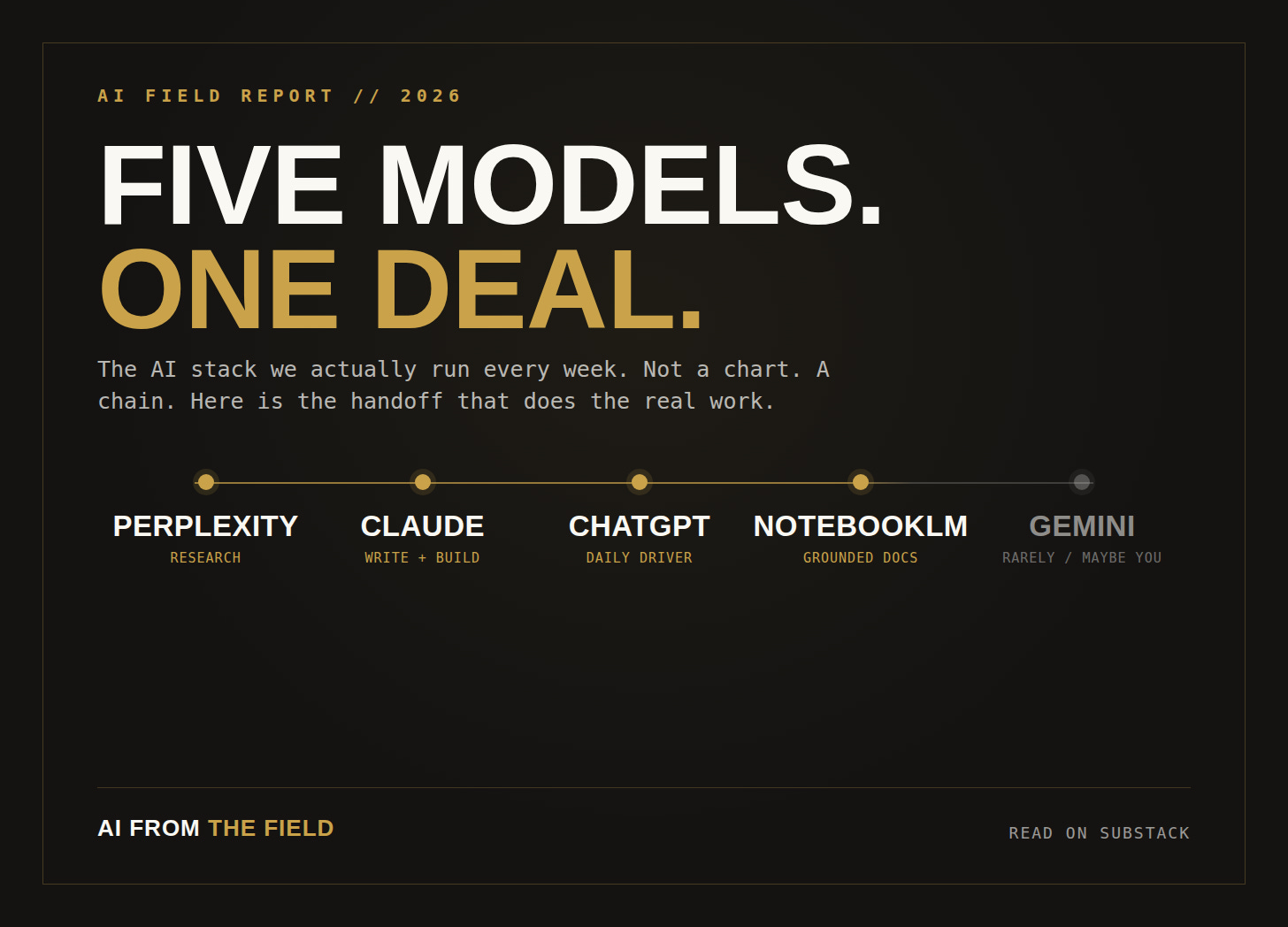
We run five models every week against real listings, real research, and real builds. Here’s the part the charts miss: we don’t use them in lanes. We use them in a chain. One hands off to the next, and knowing the handoff is worth more than knowing any single tool.
Before you read this: you don’t have to run it like we do
One thing up front, because it matters. The chain is how we work. It is not a rule you have to follow.
If you only use one model, that’s fine. If you use two and never hand off between them, that’s fine too. Plenty of agents get real value from a single tool used well, and adding more before you’ve mastered one usually just adds friction.
So read this for what it is. A field guide to what each tool is actually good at, which ones pair well together, and where the seams are. The goal is to help you see the options clearly and pick what fits your work, not to talk you into copying our setup. Take the parts that help. Leave the rest.
With that said, here’s the stack.
Subscribe to get field reports like this in your inbox.
First, the roster
If you’re still early with AI, start here. Five models, five jobs, plain language. If you already run a stack, skip to the second half where it gets messy.
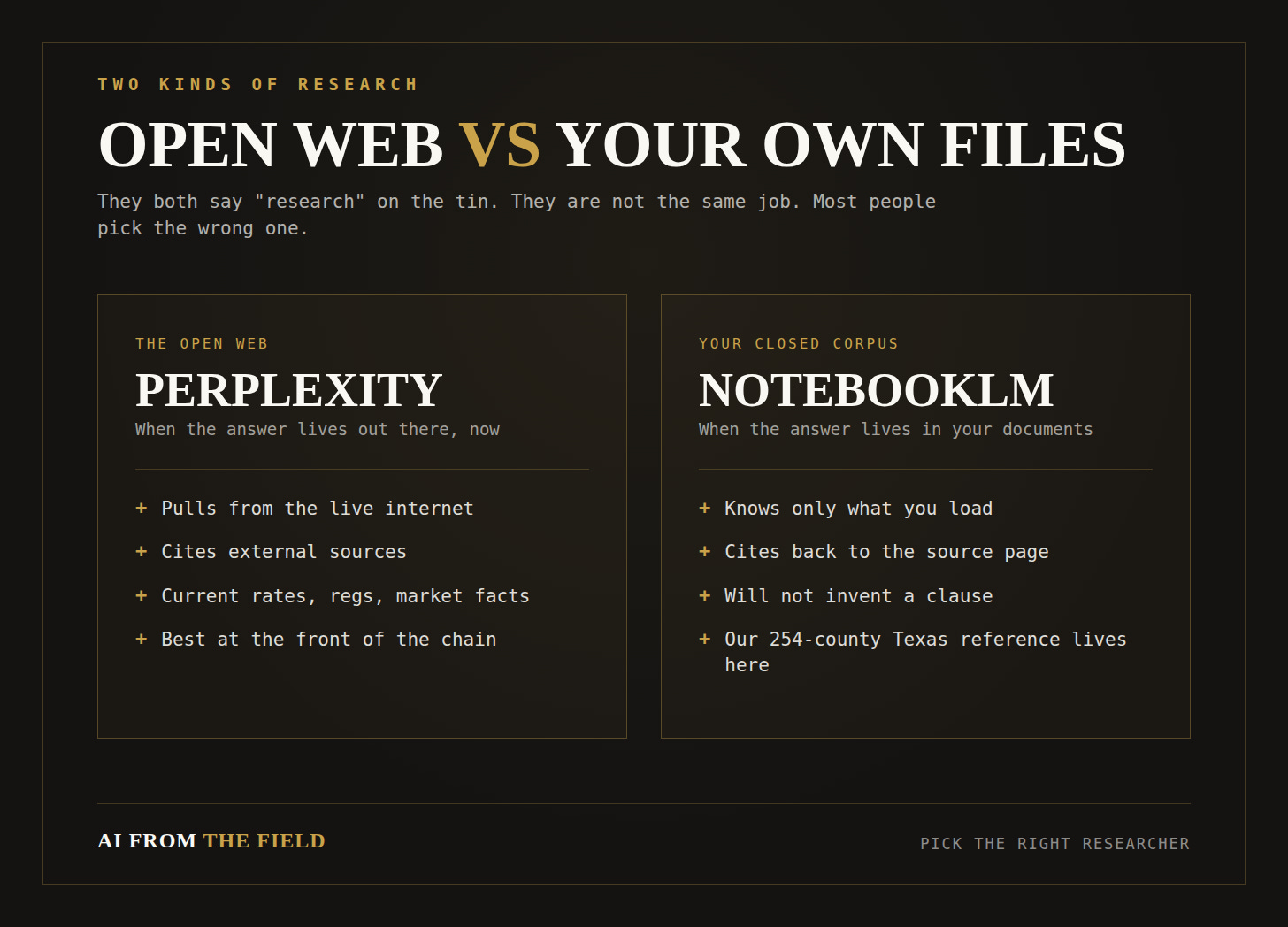
Perplexity is the researcher. It answers from the live web and cites every source. When we need current facts that can’t be wrong, like a tax rate, a flood designation, or a regulation that changed last quarter, this is where we start. It is the front of everything we do.
Claude is the writer and the builder. Once research is gathered, Claude turns it into blogs, Substacks, and the graphics that go with them. It also runs our build work through Claude Code, and we are starting to lean on Claude Design for visuals. The tone holds up on documents where the words matter.
ChatGPT is the daily driver. It lives on our team account and runs constantly: land CMA work, coding through Codex, scheduled tasks, ongoing projects. It is the workhorse that just stays open.
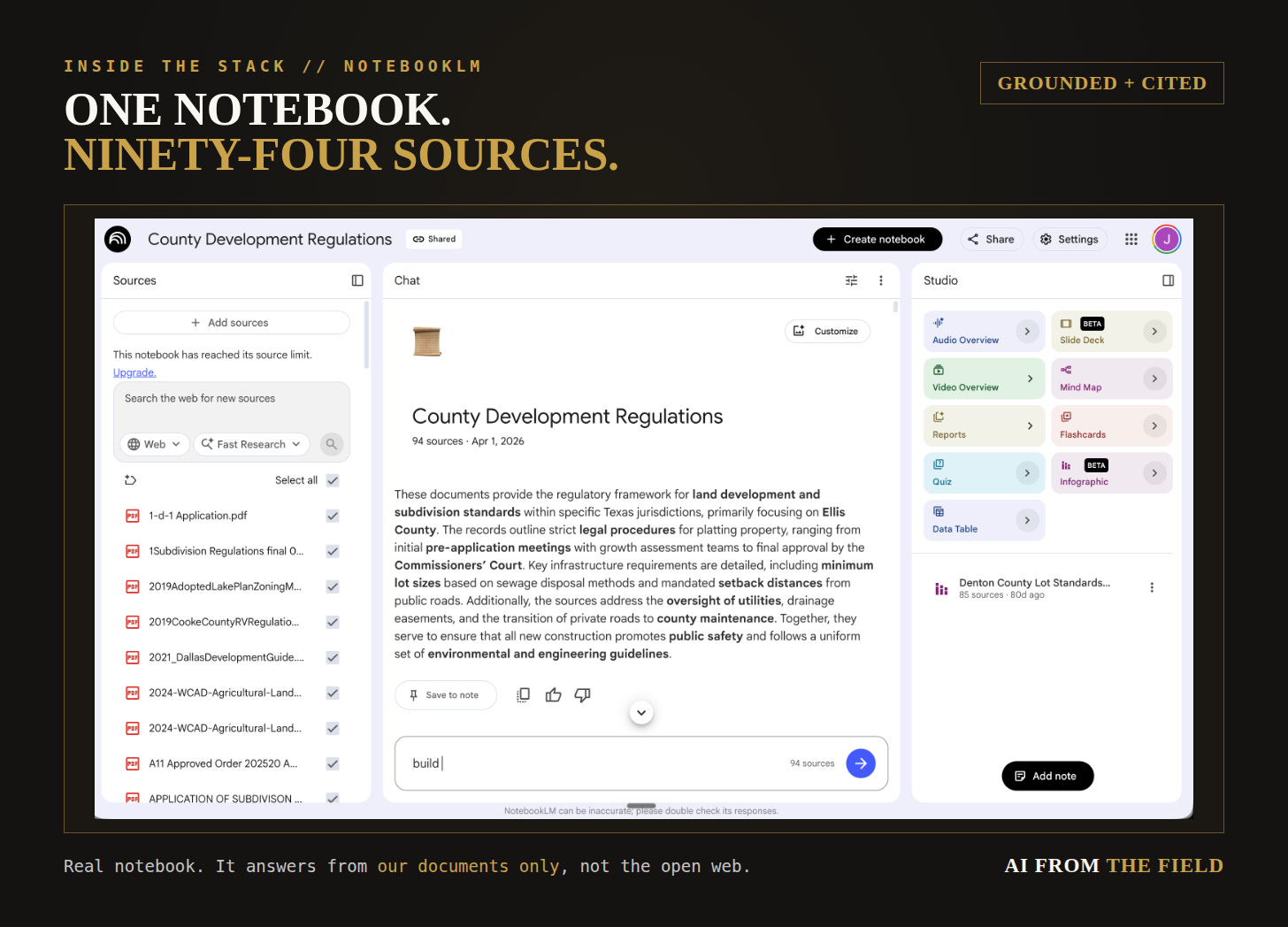
NotebookLM is the grounded researcher. This one only knows what you give it, and that is the entire point. We loaded a reference covering all 254 Texas counties into it, feed it YouTube videos to pull from, and use it to research against a closed set of documents. It does not wander off and invent a clause, because it only knows the file in front of it.
Gemini is the one we rarely open. More on that below, because honesty about what you don’t use is more useful than padding a list.
Now the part nobody publishes
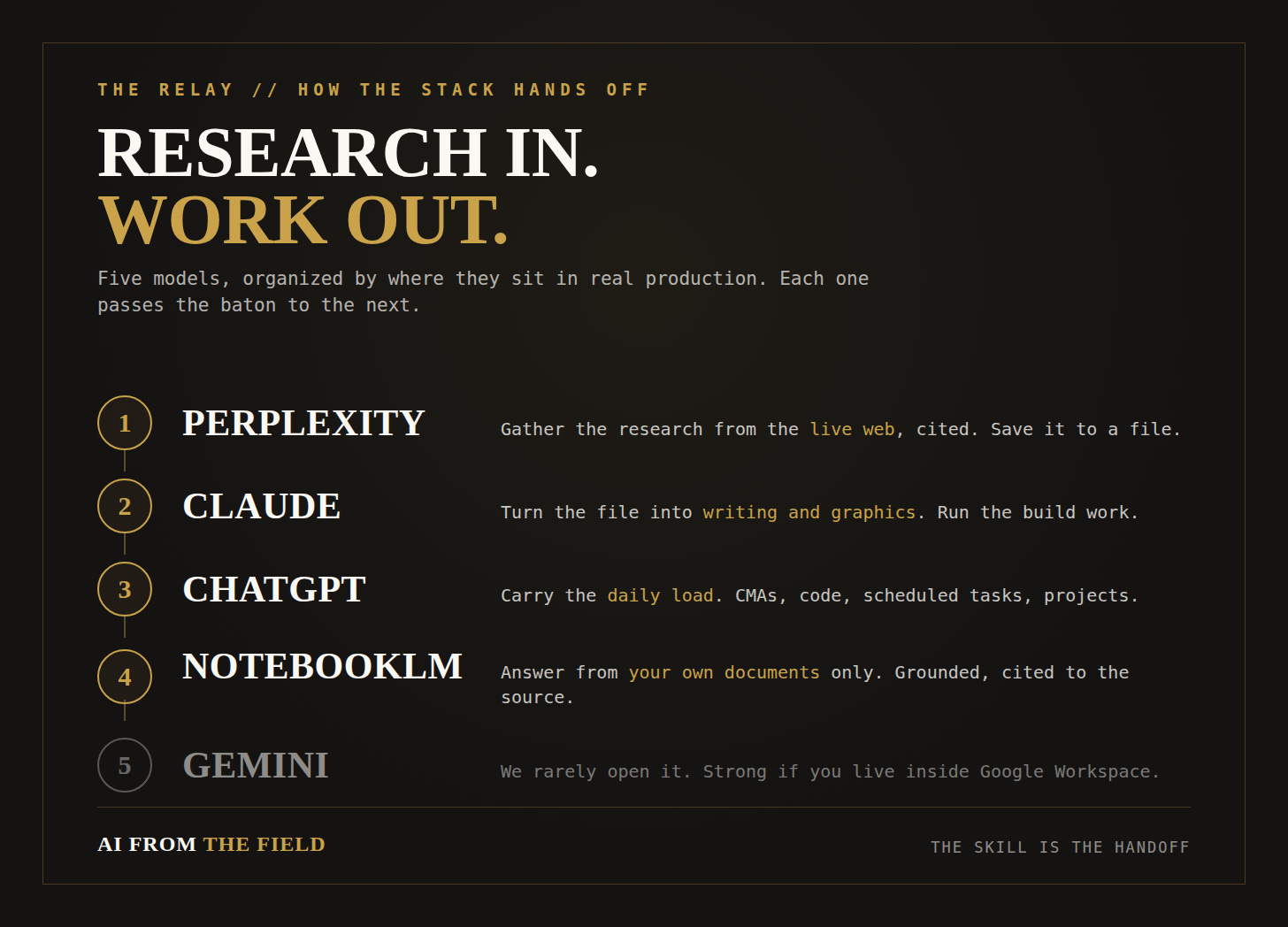
Here is where the tidy chart falls apart. We don’t pick one model per task. We run a relay, and the value is in the baton pass.
Research starts in Perplexity, then leaves
Perplexity is where the research happens. But it is not where the work ends. We pull findings, save them to a file, and that file becomes the raw material for whatever comes next.
That distinction matters. Perplexity is built to gather, not to write. Asking it to do the finished blog is asking the wrong tool to leave its lane. Gather there, then move.
The file moves to Claude
The research file goes into Claude, and Claude does two different jobs with it.
First, writing. Blog posts, Substack pieces, the graphics that ship alongside them. The output reads like a person wrote it, which is the whole reason this seat belongs to Claude and not the gathering tool.
Second, building. We run Claude Code for development work and have started using Claude Design for visuals. Same model, two completely different jobs, and neither one is research.
Two coding agents, not one
Here is a detail most agents aren’t ready for, and that’s fine. We run Claude Code and OpenAI Codex side by side.
If you’re early, ignore this and pick one. If you’re deeper in, the takeaway is that “one AI for coding” stops being true the moment you’re doing real build work. Different agents have different strengths, and running two is a choice, not a redundancy.
ChatGPT carries the daily load
While the writing chain runs, ChatGPT handles the operational weight. Land CMA work, Codex, scheduled tasks, the projects that need a tool open all day. It earns its seat not by being best at one dramatic thing, but by being reliable at the boring volume that actually runs a business.
NotebookLM answers from your own world
When the question is “what does this document say,” not “what does the web say,” the tool changes. NotebookLM only knows the corpus you load. Our 254-county reference lives there. YouTube research lives there. Anything where we need answers grounded in a fixed set of sources, cited back to the source, lives there.
This is the split most people get wrong. Perplexity for the open web. NotebookLM for your own files. They both say “research” on the tin, and they are not the same job.
And Gemini, honestly
We rarely use Gemini. That’s the truth, and pretending otherwise to round out a list of five would undercut everything else here.
But others build their whole workflow around it, and there are real reasons to. If you live inside Google Workspace, Gemini sits natively in Docs, Gmail, and Drive, which removes a lot of copy-paste friction. Its long-document handling is genuinely strong. If your day already runs through Google, it may earn a bigger seat in your stack than it does in ours.
The point is not that Gemini is weak. The point is that the right stack is the one matched to how you actually work, not the one some chart told you to assemble.
The takeaway
Stop asking “which AI is best.” It’s the wrong question, and the answer changes every few months anyway.
Ask instead: what is the chain? Where does research start, where does it get written, where does it get built, and where does it get grounded in your own documents? Once you can see the relay, the individual tools stop mattering as much, because you can swap any single one when a better version ships next quarter.
Five models, one deal. The skill isn’t picking the winner. It’s running the handoff.
If this gave you a clearer way to think about your own stack, subscribe. Everything here comes from active production, not a chart.
This was a great post!!! Thanks for sharing it.
Always best to use what’s best not what’s convenient!